






3.2M-line Java framework modernization
Struts, Hibernate and EJB components transformed to Java Spring MVC with automated unit tests and zero user-experience impact.

ASIMOV connects source understanding, target intent, specification-as-code, agentic execution, continuous validation and retained engineering knowledge in one controlled lifecycle.
Smarter People focuses on the individual experience of work. We help employees and customers find the right information faster, understand context, make better-informed decisions, complete routine interactions with less effort, and adopt AI confidently. The goal is to improve individual productivity by reducing cognitive load and time lost to search, interpretation, and repetitive work, giving people more capacity for judgment, creativity, customer interaction, and higher-value work.
People spend too much time searching for information, interpreting fragmented knowledge, switching between systems, and repeating routine work, all of which directly limit productivity. At the same time, enterprises are rolling out copilots and AI platforms that often lack role-specific context, trusted enterprise knowledge, or a clear adoption model. Instead of improving productivity, AI can become another tool people need to learn, verify, and work around.
Role-aware AI assistance. We give employees and customers assistance across the moments where people lose time, context, and productivity: finding and applying knowledge, supporting decisions, completing common requests, and learning new ways of working with AI.
Knowledge and adoption foundation. We build the enterprise knowledge foundation and adoption model required for these capabilities to become trusted parts of everyday work and deliver sustained productivity improvement.
Trusted, grounded answers. Assistance draws on governed enterprise context rather than raw retrieval, so people get consistent, cited answers they can act on with confidence.
Ingest
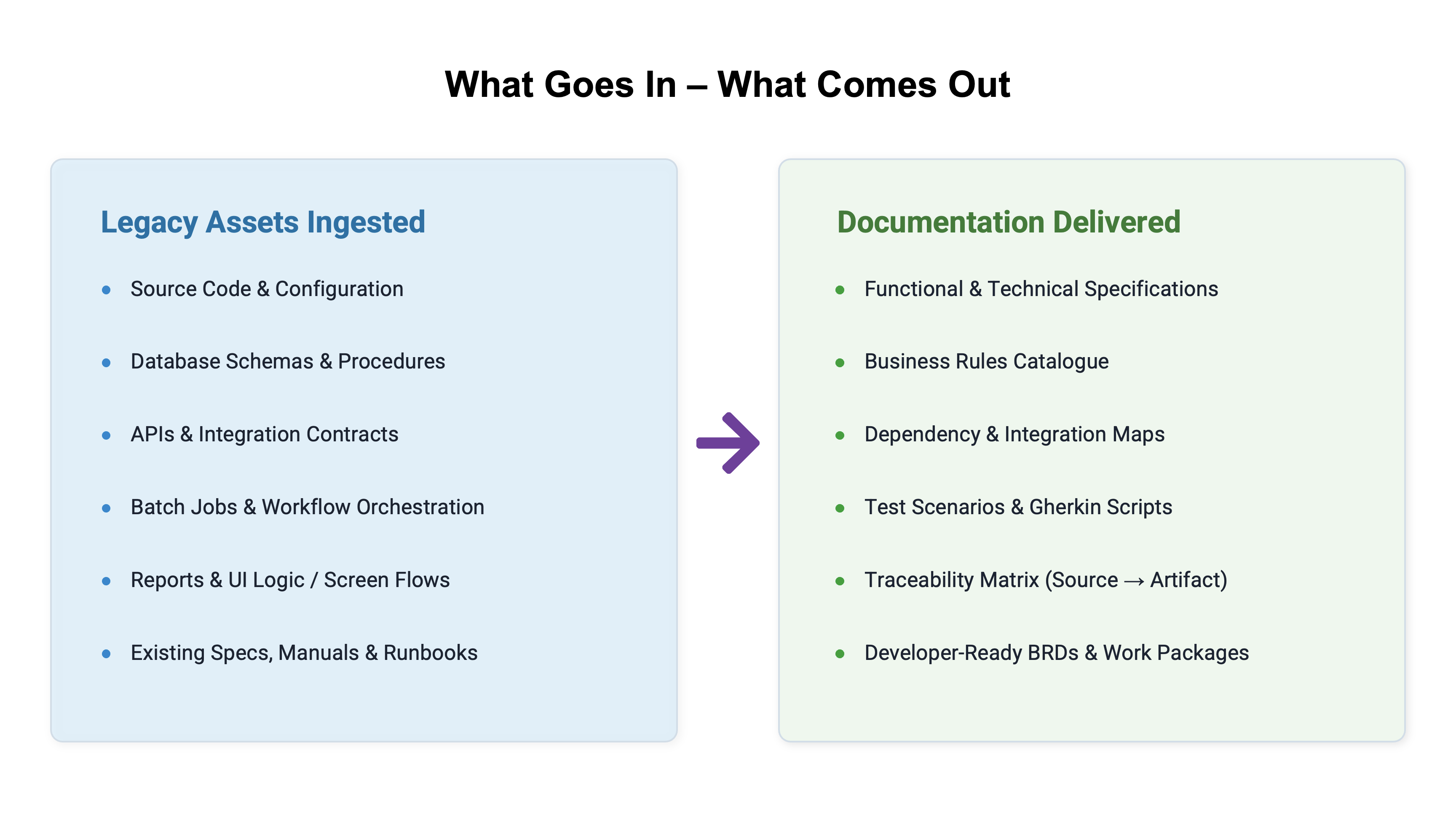
Understanding a legacy system takes more than reading its code. ASIMOV analyzes every artifact that defines how the system is built and how it runs.
Source code, configuration, modules and build structures
Database schemas, procedures, files and data models
APIs, messages, batch jobs, schedulers and reports
Screens, journeys, roles, calculations and validations
Tests, runbooks, manuals, target standards and architecture blueprints
+
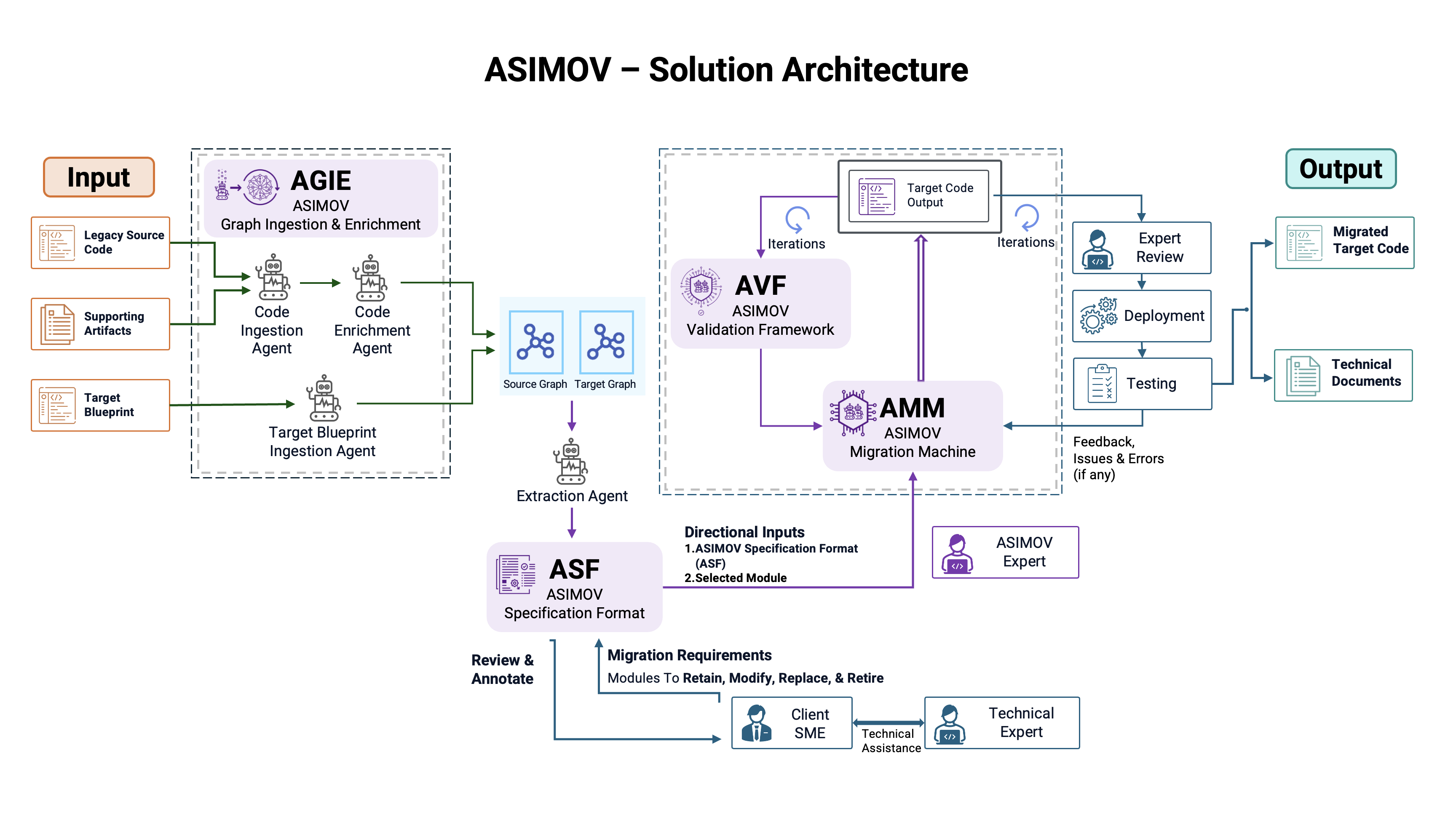
AGIE - ASIMOV Graph Ingestion & Enrichment
Language-aware parsing and enrichment convert code and supporting assets into connected entities, relationships and evidence that agents and reviewers can use.
Applications, modules, classes, methods, calls, jobs, tables, interfaces and dependencies.
Business rules, calculations, process paths, data movement, exceptions and user journeys.
Descriptions, risk signals, duplicate logic, technical debt, confidence and review status.
One Intelligence Core
Six integrated layers that transform legacy code into actionable knowledge
Shape and prioritize AI opportunities across people, processes, and products, with clear value, readiness, and execution paths.
Reconstruct complex applications, define the target state, and execute controlled modernization or software transformation with ASIMOV.
Carry modernized system knowledge forward into new features and services so the application can evolve without immediately rebuilding architectural debt.
Use business and engineering evidence to decide where to invest, consolidate, re-engineer, maintain, or retire across the product portfolio.
Converts source assets into a connected system graph covering code, data, rules, dependencies and flows.
Identifies execution paths, validations, calculations, integration points and impact relationships.
Generates functional, technical, integration, data and test documentation
Links source components, generated artifacts, target requirements, decisions and validation evidence.
Teams ask questions across applications, generated documents, rules, dependencies and migration artifacts.
Users review, edit, enrich and capture approved future-state changes or non-as-is requirements.
ASF - ASIMOV Specification Format
The ASIMOV Specification Format connects selected scope, source-to-target mappings, architectural constraints, approved business deltas, transformation rules, test expectations and acceptance criteria.
Retain, modify, replace, consolidate or retire decisions
Target components, service boundaries and platform patterns
Business-rule traceability and approved future-state change
Data, interface, security and non-functional requirements
Versioned review comments, exceptions and approvals
Retain, modify, replace, consolidate or retire decisions
Translate approved target architecture, mappings, rules and acceptance criteria into ASF.
Agents transform, generate, compile and remediate within approved constraints.
Check architecture, functionality, interfaces, data and behavioural evidence continuously.
Carry migration knowledge into the target graph for impact-aware engineering.
Shape and prioritize AI opportunities across people, processes, and products, with clear value, readiness, and execution paths.
Reconstruct complex applications, define the target state, and execute controlled modernization or software transformation with ASIMOV.
Carry modernized system knowledge forward into new features and services so the application can evolve without immediately rebuilding architectural debt.
Use business and engineering evidence to decide where to invest, consolidate, re-engineer, maintain, or retire across the product portfolio.
+
AMM - ASIMOV Migration Machine
The Migration Machine orchestrates analysis, planning, transformation, generation, compilation, testing and remediation agents. The normal cycle is autonomous; engineers improve the factory and govern exceptions.
Shape and prioritize AI opportunities across people, processes, and products, with clear value, readiness, and execution paths.
Reconstruct complex applications, define the target state, and execute controlled modernization or software transformation with ASIMOV.
Carry modernized system knowledge forward into new features and services so the application can evolve without immediately rebuilding architectural debt.
Use business and engineering evidence to decide where to invest, consolidate, re-engineer, maintain, or retire across the product portfolio.
Select patterns, sequence dependencies and define bounded transformation work packages.
Convert, refactor, decompose, generate interfaces, configuration, data objects and tests.
Use build feedback to resolve generated issues through iterative agent loops.
Produce target code and evidence aligned to customer repositories and delivery controls.
Struts, Hibernate and EJB components transformed to Java Spring MVC with automated unit tests and zero user-experience impact.
Core policy-lifecycle workloads modernized from 600K LOC COBOL toward .NET 8 microservices and a React frontend.
Mission-critical desktop estate reconstructed into a scalable web platform with ~60% effort reduction vs manual.
300K LOC monolith decomposed into modular .NET Core with a refreshed React frontend.
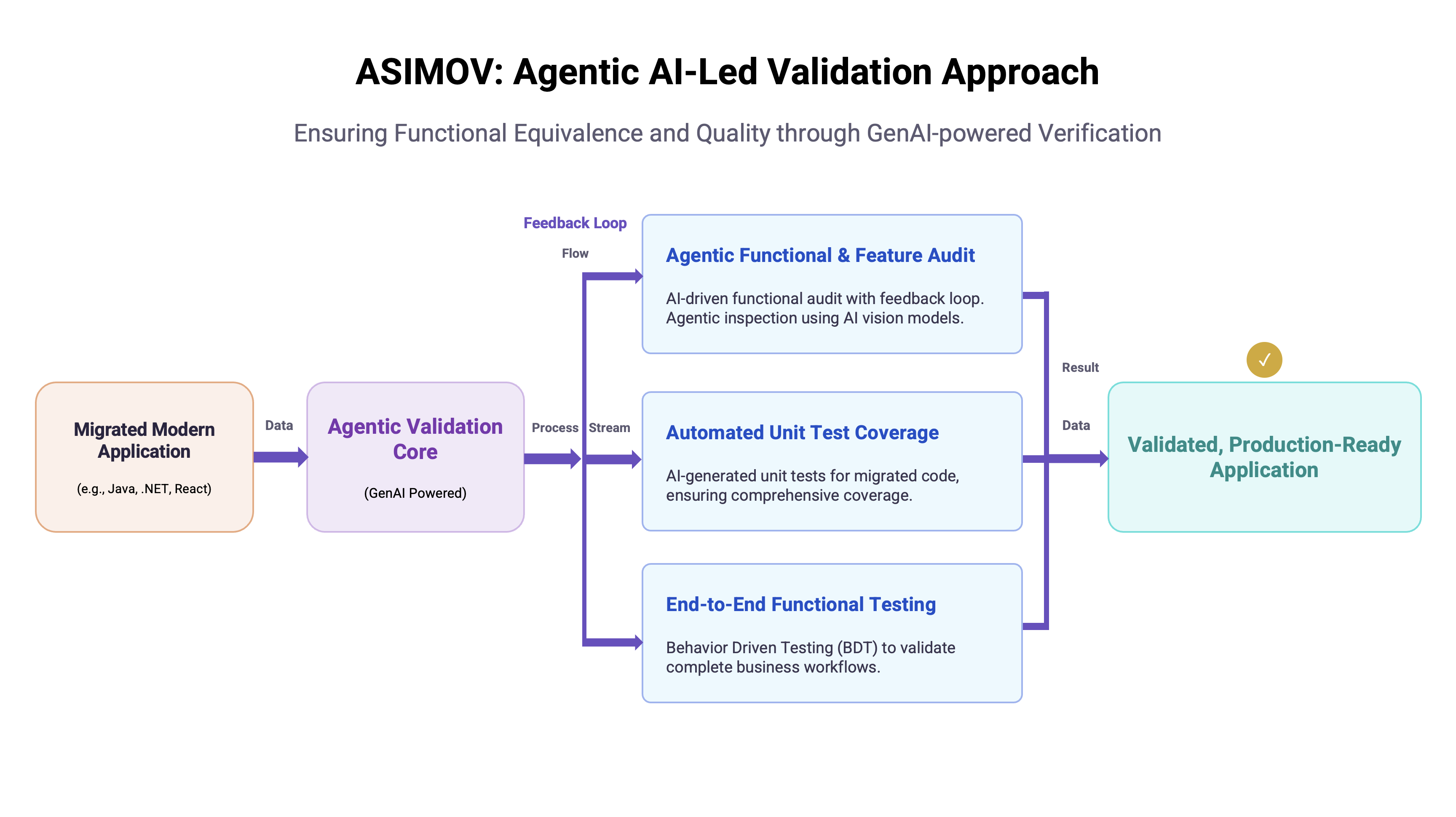
AVF - ASIMOV Validation Framework
The Validation Framework checks specification and architecture conformance, compilation, tests, interfaces, data reconciliation and behavioral evidence.
Shape and prioritize AI opportunities across people, processes, and products, with clear value, readiness, and execution paths.
Reconstruct complex applications, define the target state, and execute controlled modernization or software transformation with ASIMOV.
Carry modernized system knowledge forward into new features and services so the application can evolve without immediately rebuilding architectural debt.
Use business and engineering evidence to decide where to invest, consolidate, re-engineer, maintain, or retire across the product portfolio.
Struts, Hibernate and EJB components transformed to Java Spring MVC with automated unit tests and zero user-experience impact.
Core policy-lifecycle workloads modernized from 600K LOC COBOL toward .NET 8 microservices and a React frontend.
Mission-critical desktop estate reconstructed into a scalable web platform with ~60% effort reduction vs manual.
300K LOC monolith decomposed into modular .NET Core with a refreshed React frontend.
+
One intelligence core
Use ASIMOV for discovery, migration readiness, full modernization, rationalization or continuous maintenance.
Shape and prioritize AI opportunities across people, processes, and products, with clear value, readiness, and execution paths.
Reconstruct complex applications, define the target state, and execute controlled modernization or software transformation with ASIMOV.
Carry modernized system knowledge forward into new features and services so the application can evolve without immediately rebuilding architectural debt.
Use business and engineering evidence to decide where to invest, consolidate, re-engineer, maintain, or retire across the product portfolio.
Reconstruct application knowledge and make business rules, dependencies and flows reviewable.
Establish scope, target mappings, sequencing, complexity and a representative proof wave.
Execute agentic source-to-target transformation with continuous validation and delivery evidence.
Use the target graph for impact analysis, onboarding, change, rationalization and consolidation.
Documented Smarter Products engagements span brownfield modeling, continuous engineering, and program-scale modernization.
A 2M+ line codebase modeled in approximately 2-3 weeks; impact analysis across a 1.6M-line application graph completed in about eight minutes.
93.4% test coverage generated from the model, with 23% fewer defects reported on the same team and codebase after adoption.
15M+ lines modernized across mainframe, Java, and desktop systems.
We start with knowledge friction, cognitive load, and repetitive effort rather than leading with chatbot or automation features.
Semantic Engineering, SKG, and ECL create reusable grounding so people get more consistent answers across AI experiences.
Copilots support knowledge and decisions; SPEX is brought in only where a user interaction needs governed action or deeper engineering.
We integrate with the productivity, service, knowledge, and business platforms people already use instead of creating another destination.
KAPS, AI Prism, role-based enablement, and SPEX adoption capabilities connect opportunity selection, user support, evidence, and scale.
The combined experience of approximately 5,000 engineers and a proven platform set stands behind each rollout, so what works for one team can extend across functions with the same grounding and governance.
Living Target Graph
ASIMOV carries transformed components, dependencies, business rules, source-to-target mappings, specifications, decisions, tests and validation evidence into the target graph.
Maintenance teams can understand what a component does, why it exists, what it affects and which tests should run before change is released. Teams work from a live, queryable system map rather than rediscovering the application from scratch.
Shape and prioritize AI opportunities across people, processes, and products, with clear value, readiness, and execution paths.
Reconstruct complex applications, define the target state, and execute controlled modernization or software transformation with ASIMOV.
Carry modernized system knowledge forward into new features and services so the application can evolve without immediately rebuilding architectural debt.
Use business and engineering evidence to decide where to invest, consolidate, re-engineer, maintain, or retire across the product portfolio.
Struts, Hibernate and EJB components transformed to Java Spring MVC with automated unit tests and zero user-experience impact.
Core policy-lifecycle workloads modernized from 600K LOC COBOL toward .NET 8 microservices and a React frontend.
Mission-critical desktop estate reconstructed into a scalable web platform with ~60% effort reduction vs manual.
300K LOC monolith decomposed into modular .NET Core with a refreshed React frontend.
Trace affected services, data, rules, journeys, tests and interfaces before implementation.
Refresh approved functional and technical knowledge as the application evolves.
Give new teams searchable, traceable system context from day one.
Compare overlaps and plan consolidation across applications and platforms.
A technical demonstration shows ingestion, graph queries, target mapping, agentic execution, validation and retained target knowledge.
Smarter People is Accion Labs' approach to improving how employees and customers find and use enterprise knowledge, make decisions, complete routine interactions, and adopt AI in their everyday work. It combines enterprise intelligence, role-based copilots, self-service, and workforce enablement on a governed foundation.
Enterprise AI Strategy & Advisory; AI Copilot & Knowledge Assistants; Customer and Employee Self-service; AI Enablement and Workforce Adoption; Enterprise Intelligence & Knowledge Layer.
Semantic Engineering structures enterprise context as governed knowledge and relationships. SKG and ECL provide reusable grounding and source evidence, while role-based access, validation, and human oversight keep assistance appropriate to the user and use case.